
Device verification, 2026-09-23
The example app (examples/tauri-app), built from this branch, run on four Android emulators that bracket the Chromium 111 floor, plus an iOS simulator. Every screenshot below was opened and looked at before it was cited, and for each Android capture the focused window was recorded — Android 14's "built for an older version of Android" system dialog reads a lot like this guard's, so a screenshot is only attributed to the guard when the focused window is the example's own MainActivity and the UI tree's only package is app.vaam.webviewguard.example. The example targets SDK 36 (Tauri's generated gen/android/app/build.gradle.kts), and that system dialog did not appear on any arm.
Setup
| AVD | API | Image | Profile |
|---|---|---|---|
spike_api24_webview | 24 | google_apis arm64 | pixel_4, 1080×2280 @ 440 dpi |
spike_api33_webview | 33 | google_apis arm64 | same |
spike_api34_webview | 34 | google_apis arm64 | same |
spike_api36_webview | 36 | google_apis arm64 | same |
Profile read back from each device with wm size / wm density. None of the four has a real Play Store: com.android.vending is present but is a 1.8 stub that resolves no market: intent (pm query-activities for market://details?id=x: "No activities found").
Build: npm run tauri android build --debug --target aarch64 --apk, with the floor at the plugin default (111), after examples/tauri-app/android-7-jackson-workaround.zsh — without it, stock Tauri does not start on API 24 at all (see below). Each run: am force-stop, logcat -c, am start, 15 s settle, then focus, UI tree, screencap, logcat.
The four arms
| Arm | getCurrentWebViewPackage returned | Guard verdict | What appeared | Update button | Screenshot |
|---|---|---|---|---|---|
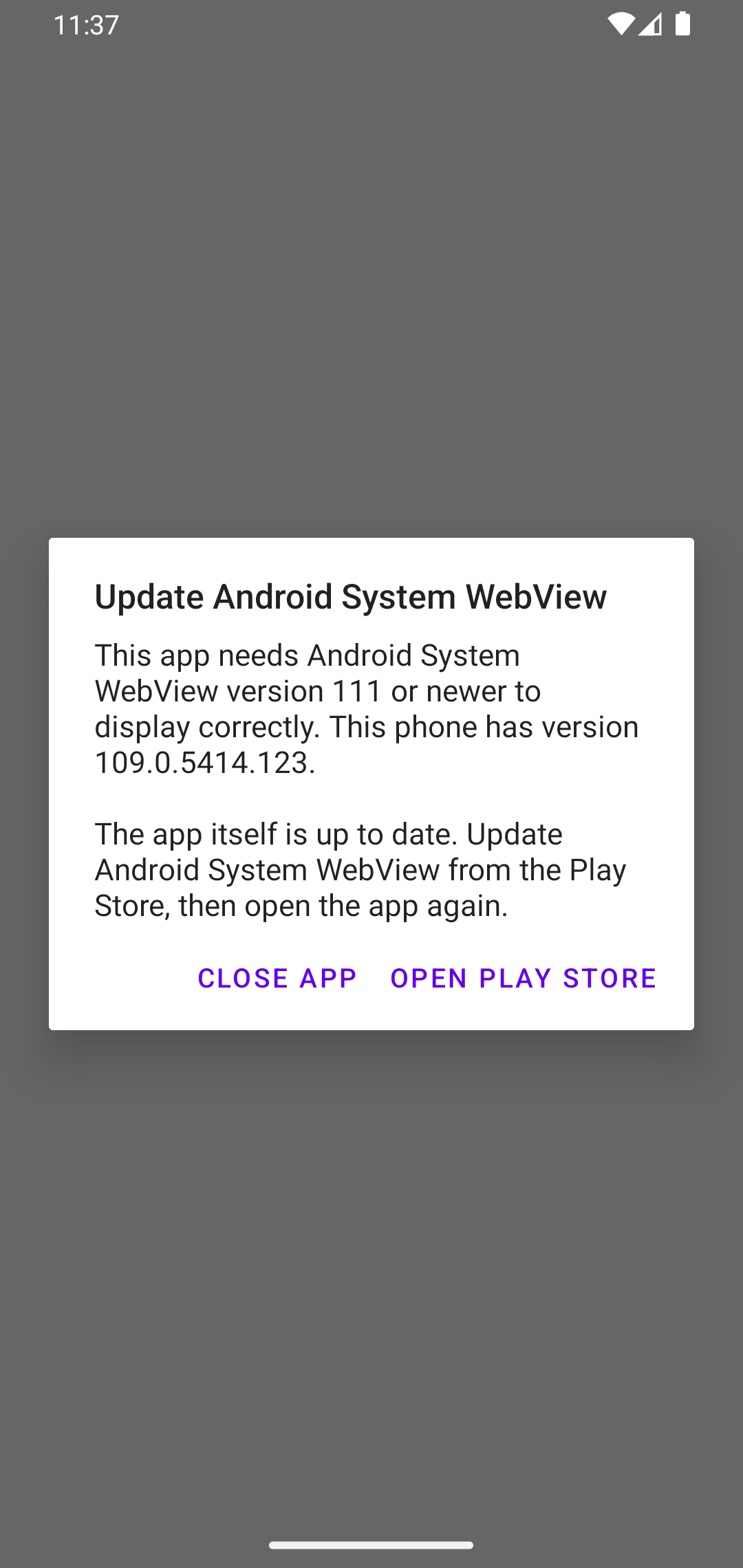
| Chromium 53 (API 24) | com.google.android.webview, 53.0.2785.124, label "Android System WebView" | below_floor | Dialog "Update Android System WebView", over a hidden WebView | market: → no handler; https://play.google.com/… → WebView Browser Tester (org.chromium.webview_shell, the image's only browser) showing the WebView listing | dialog · after Update |
| Chromium 109 (API 33) | com.google.android.webview, 109.0.5414.123, "Android System WebView" | below_floor | Dialog — instead of the app, which on this engine would have rendered legibly with every color-mix() colour wrong | market: → no handler; https → Chrome (com.android.chrome, first-run screen) | dialog · after Update · back from Chrome |
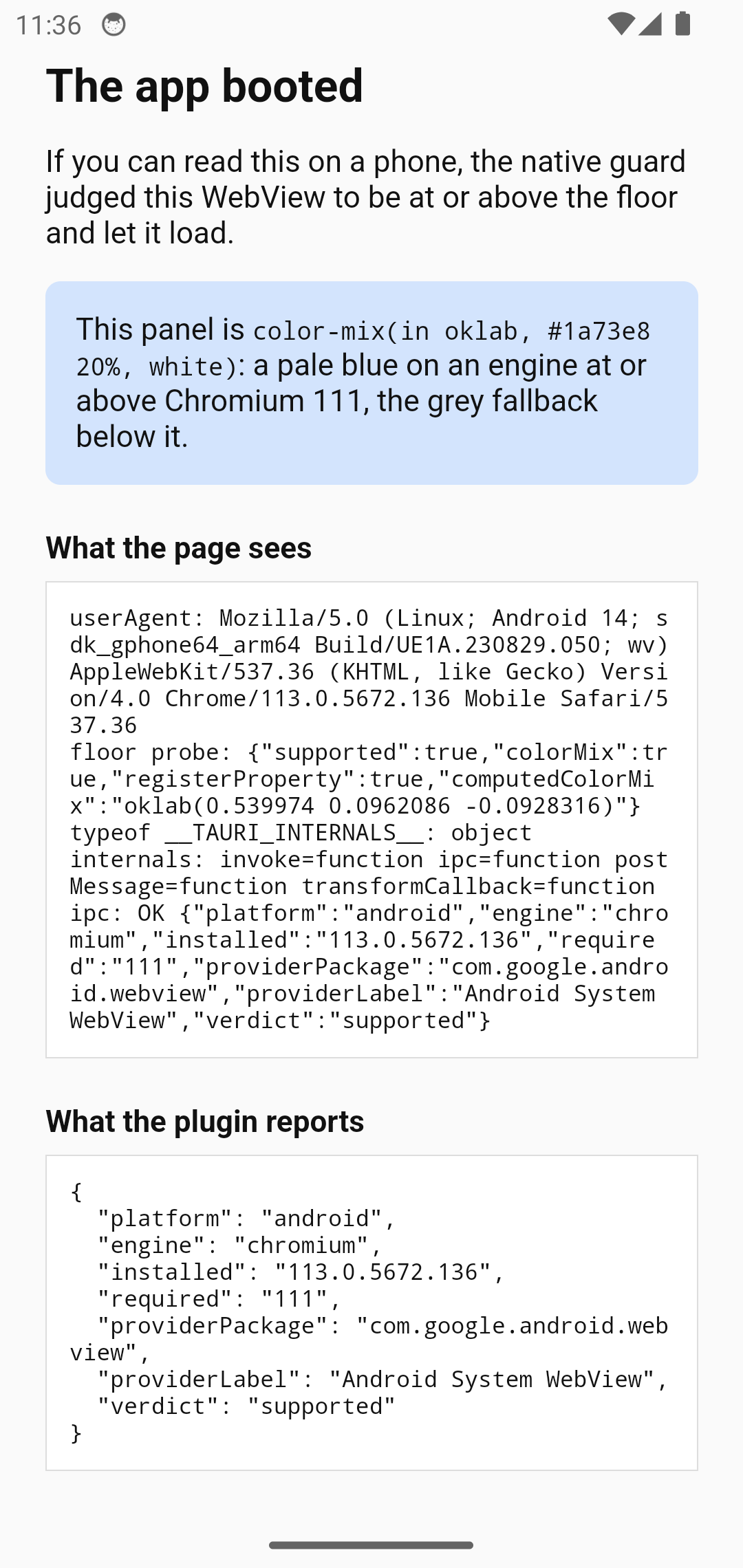
| Chromium 113 (API 34) | com.google.android.webview, 113.0.5672.136, "Android System WebView" | supported | App loads; no system dialog | — | app |
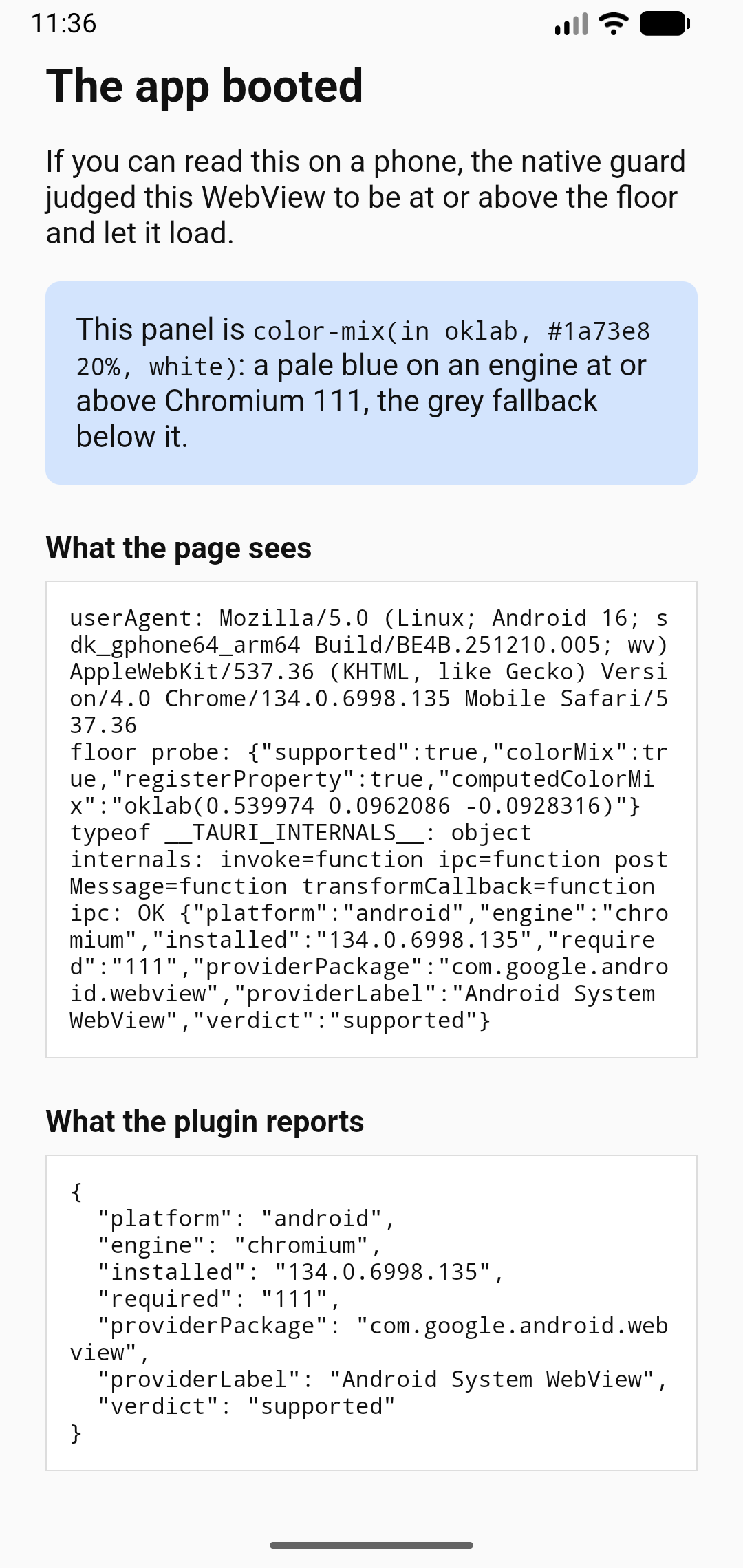
| Chromium 134 (API 36) | com.google.android.webview, 134.0.6998.135, "Android System WebView" | supported | App loads; no system dialog | — | app |
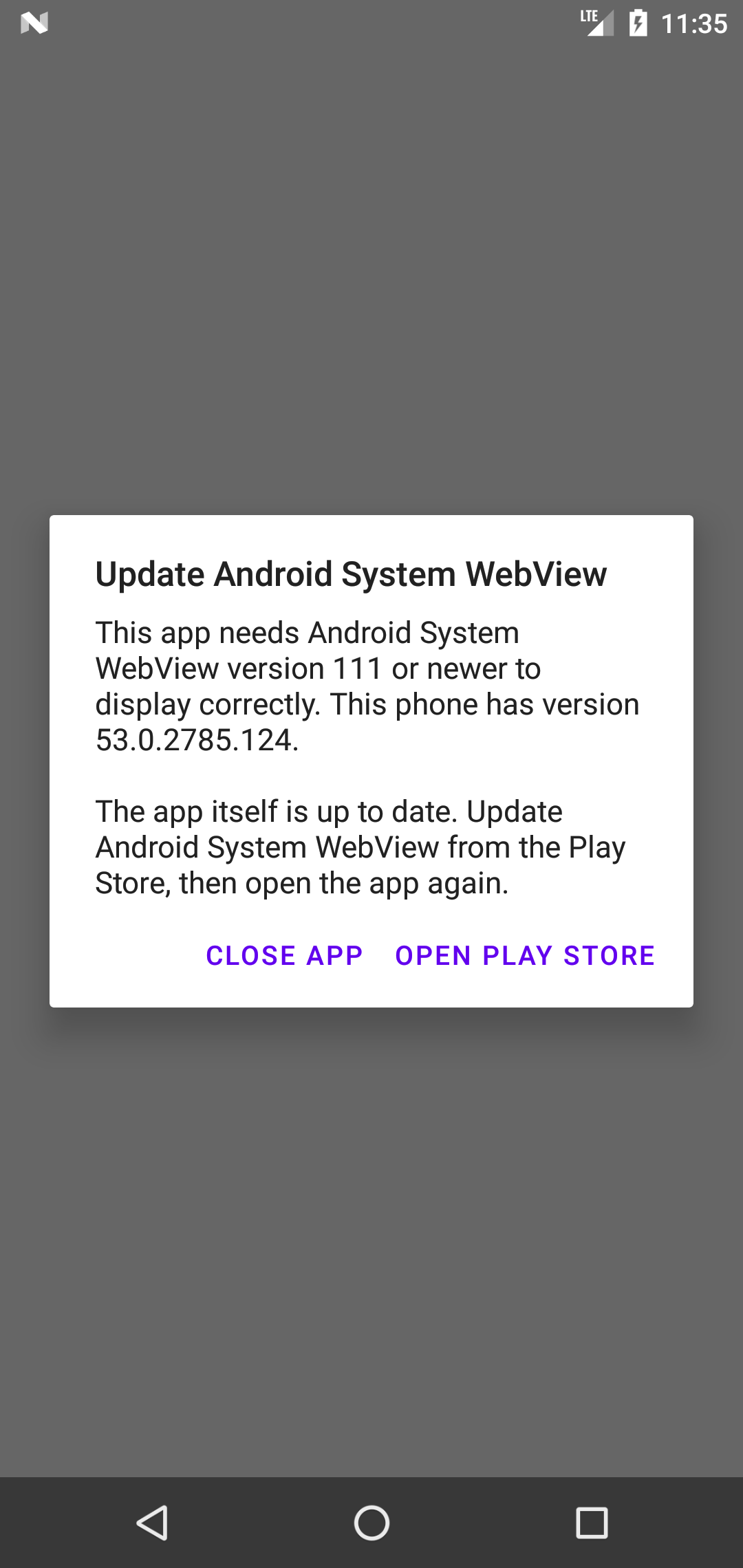
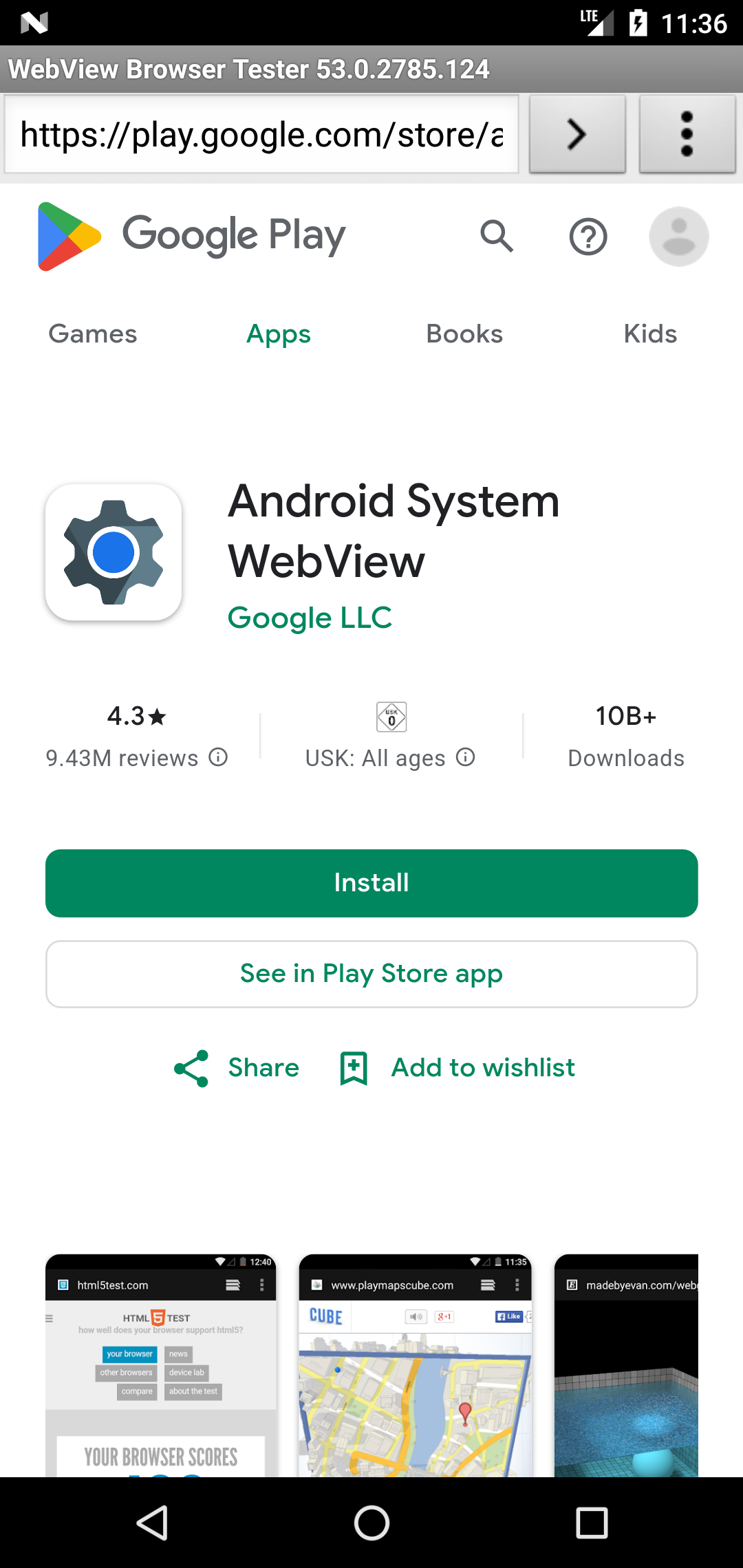
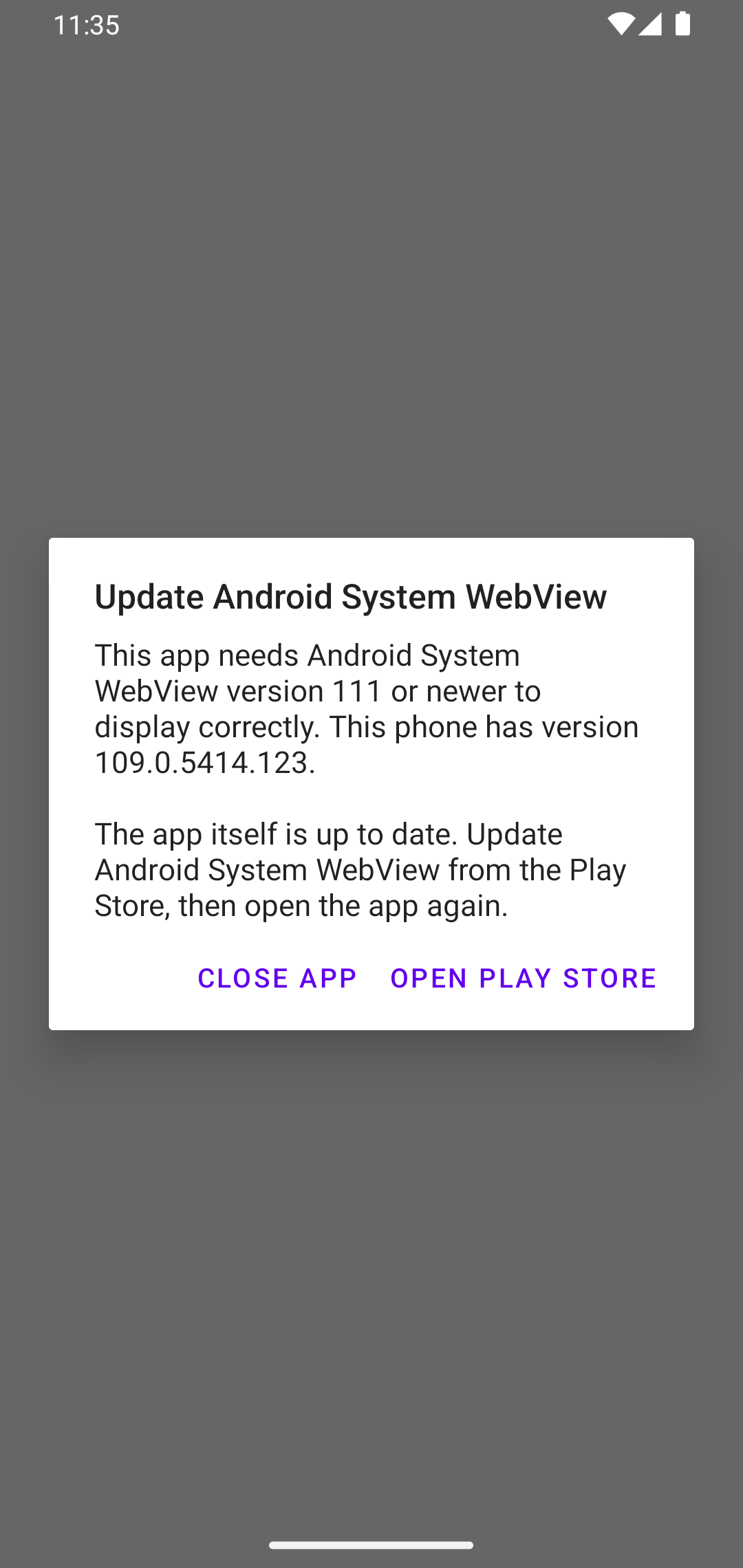
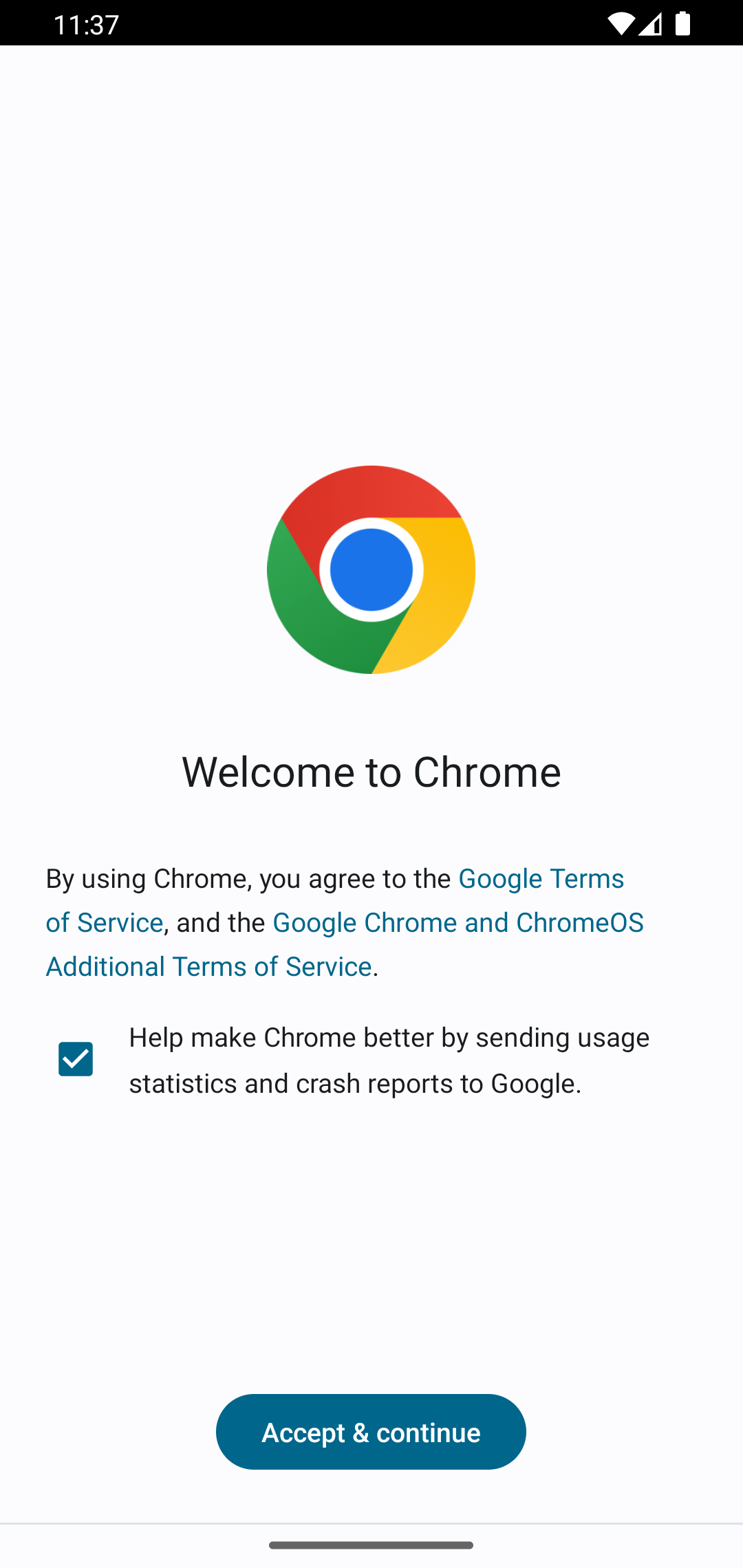
Logs and focused windows for each: logs/cr*-default.logcat.txt, logs/cr*-default.focus.txt, logs/cr*-default-update.*.
One code path covers all four, but it is two paths inside androidx. The same WebViewCompat.getCurrentWebViewPackage call returned the provider on API 24 (below API 26 androidx reaches it by reflection into WebViewFactory) and on 33/34/36 (the public API). All four returned com.google.android.webview, so these stock images never exercise the Trichrome or OEM case — "never hardcode the package" stands on the API's contract and a unit test (assess::tests::the_package_and_label_are_never_hardcoded), not on a difference observed here.
The 109 arm is the one that justifies the plugin. Below Chromium 111 the app does not go blank until Chromium 99; in between it renders subtly wrong. The guard's dialog on 109 is shown instead of that app: the logcat for the run has refused navigation to http://tauri.localhost/ and no page load started for the app URL — only for about:blank.
The dialog survives a round trip to the store. After Update opened Chrome, Back returned to the same dialog (cr109-default-after-back.png; the Update button's listener is replaced so it does not dismiss). Close app removed the task and the process (logs/cr109-close-app.txt: focus back on the previously open app, 0 recents entries, no pid).
The native verdict and the floor probe agree on every arm
The diagnostic build (WEBVIEW_GUARD_EXAMPLE_MIN_CHROMIUM=1, which lets every engine through on purpose) shows what the page itself sees:
| Arm | Native versionName major vs 111 | Probe color-mix() | Probe CSS.registerProperty | Probe computed color-mix | Probe verdict |
|---|---|---|---|---|---|
| 53 | below | false | false | rgb(18, 52, 86) (fallback: declaration dropped) | below — screenshot |
| 109 | below | false | true | rgb(18, 52, 86) | below — screenshot |
| 113 | above | true | true | oklab(0.539974 0.0962086 -0.0928316) | supported — screenshot |
| 134 | above | true | true | oklab(0.539974 0.0962086 -0.0928316) | supported — screenshot |
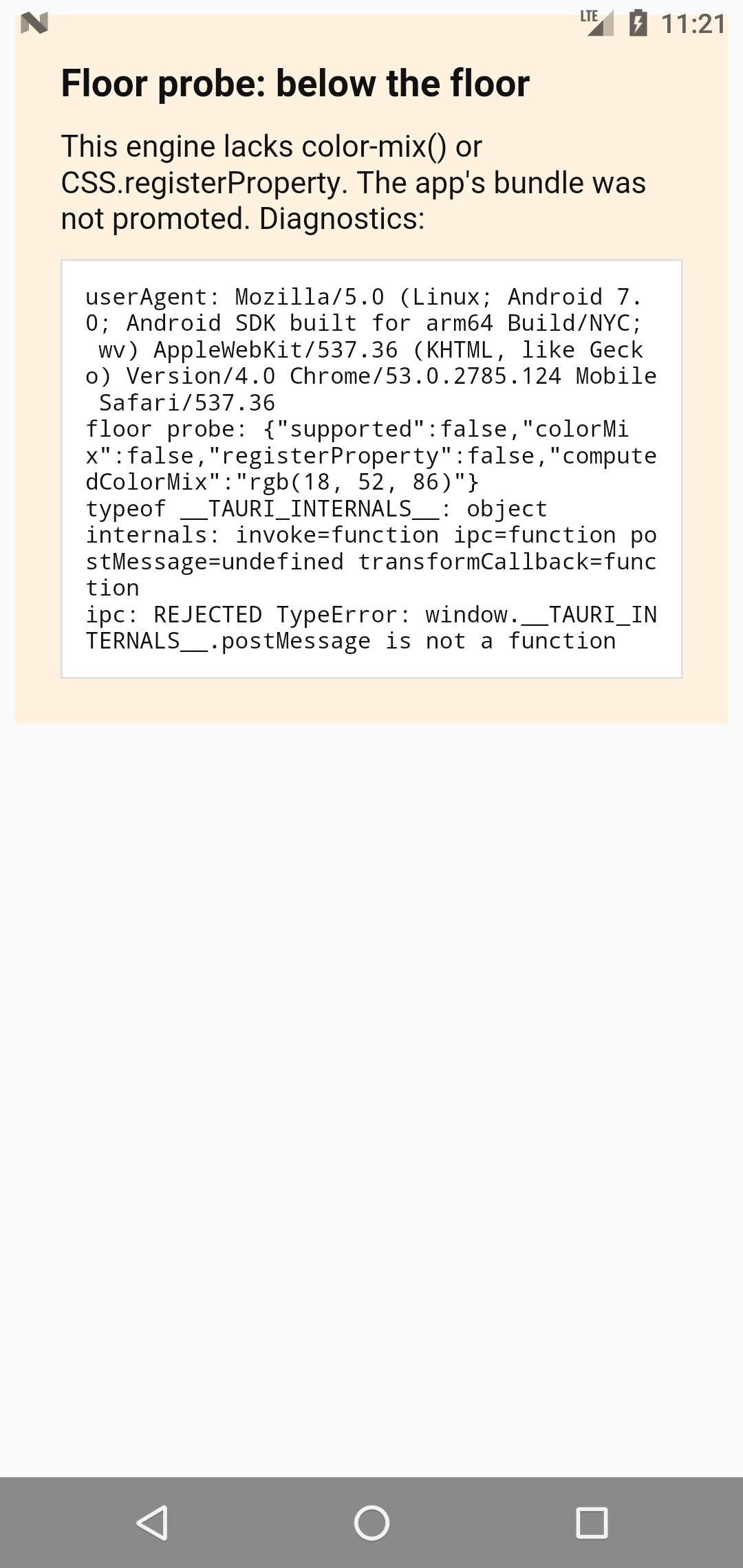
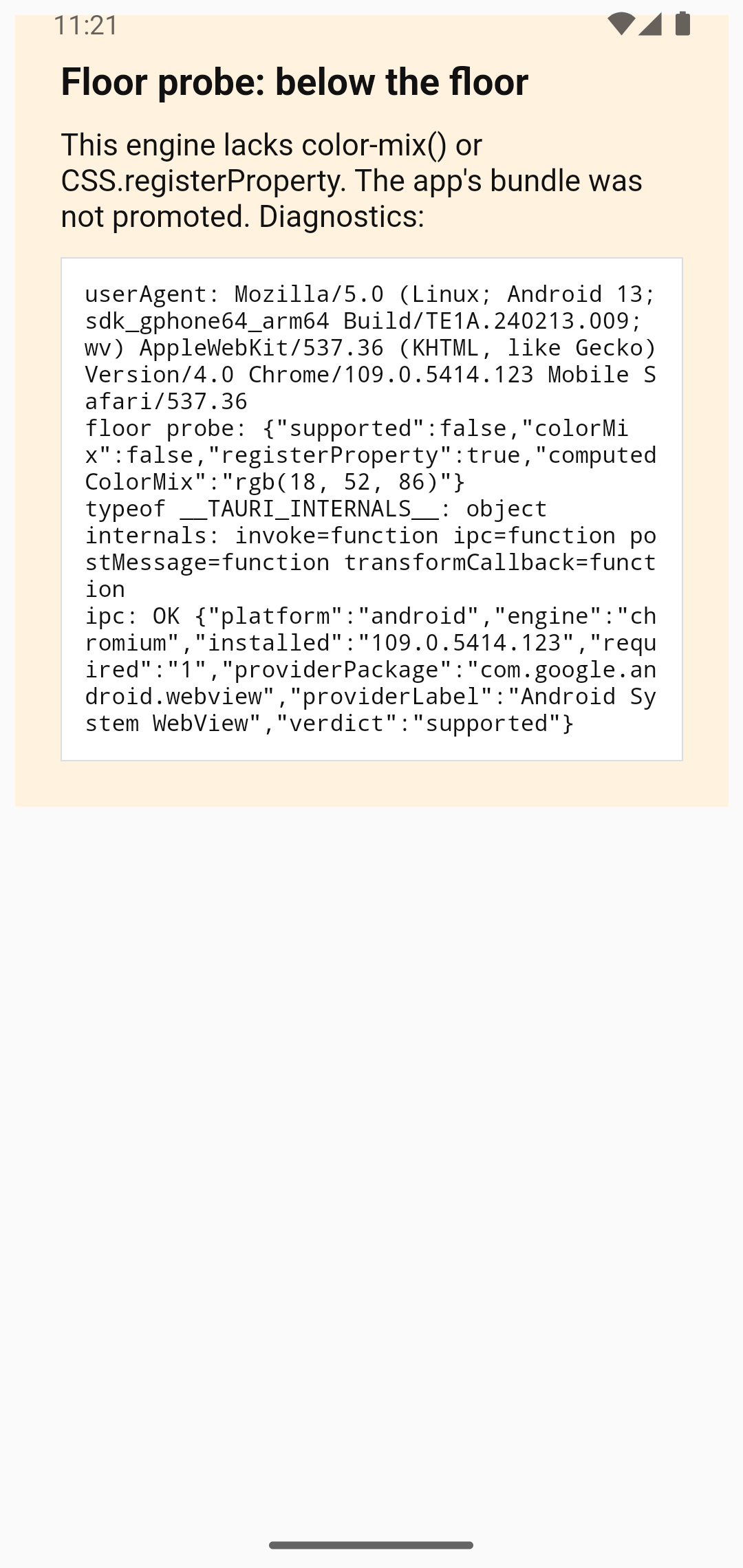
No disagreement: on these providers the versionName tracks the feature set exactly at the floor. The probe ran on Chromium 53, so its ES5 claim is proven on the engine that matters, not only by the parser test.
Does Tauri's IPC work on Chromium 53? No
From the same diagnostic run on the 53 arm (screenshot):
typeof __TAURI_INTERNALS__: object
internals: invoke=function ipc=function postMessage=undefined transformCallback=function
ipc: REJECTED TypeError: window.__TAURI_INTERNALS__.postMessage is not a function
and in logcat: Uncaught SyntaxError: Unexpected token .... The script that defines postMessage is tauri 2.11.6's scripts/ipc-protocol.js, whose line 77 is an object spread (...options, Chromium 60); it fails to parse, so every invoke() rejects. An HTML fallback page with an "Update" button calling invoke("open_store") would be dead on exactly this engine. The same probe on Chromium 109 shows postMessage=function and ipc: OK. This is why the dialog is native — and it would be native regardless.
Android 7 does not start at all on stock Tauri
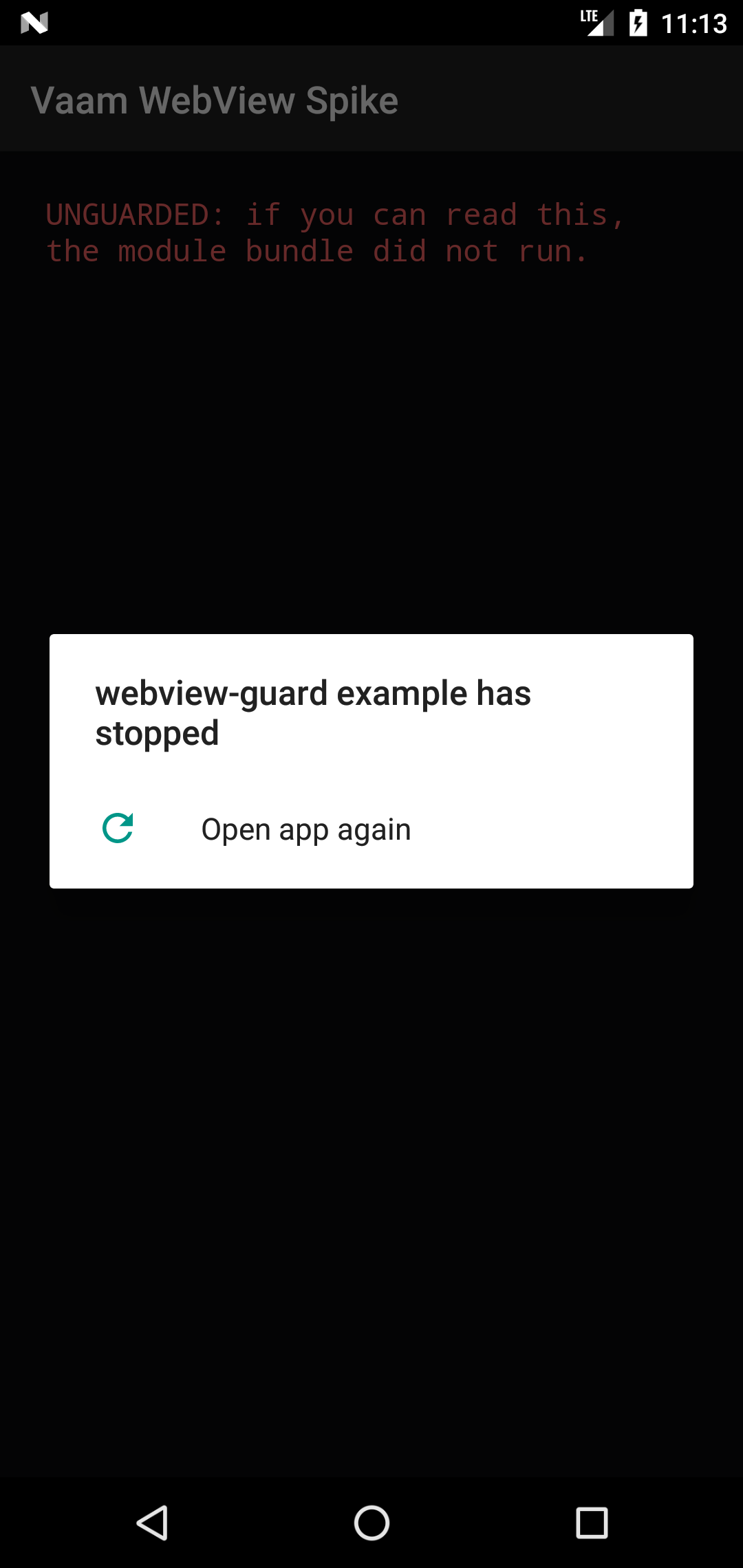
Before the Jackson workaround, the API 24 arm never reached the guard: java.lang.NoClassDefFoundError: Failed resolution of: Ljava/lang/BootstrapMethodError; from ObjectMapper.<clinit> ← app.tauri.plugin.PluginManager.<clinit> ← TauriActivity.onCreate, i.e. inside Tauri, before any plugin is constructed (screenshot: Android's own "webview-guard example has stopped"; logs/cr53-stock-tauri-crash.logcat.txt). That is tauri-apps/tauri#8788, open. upstream.json records it.
iOS
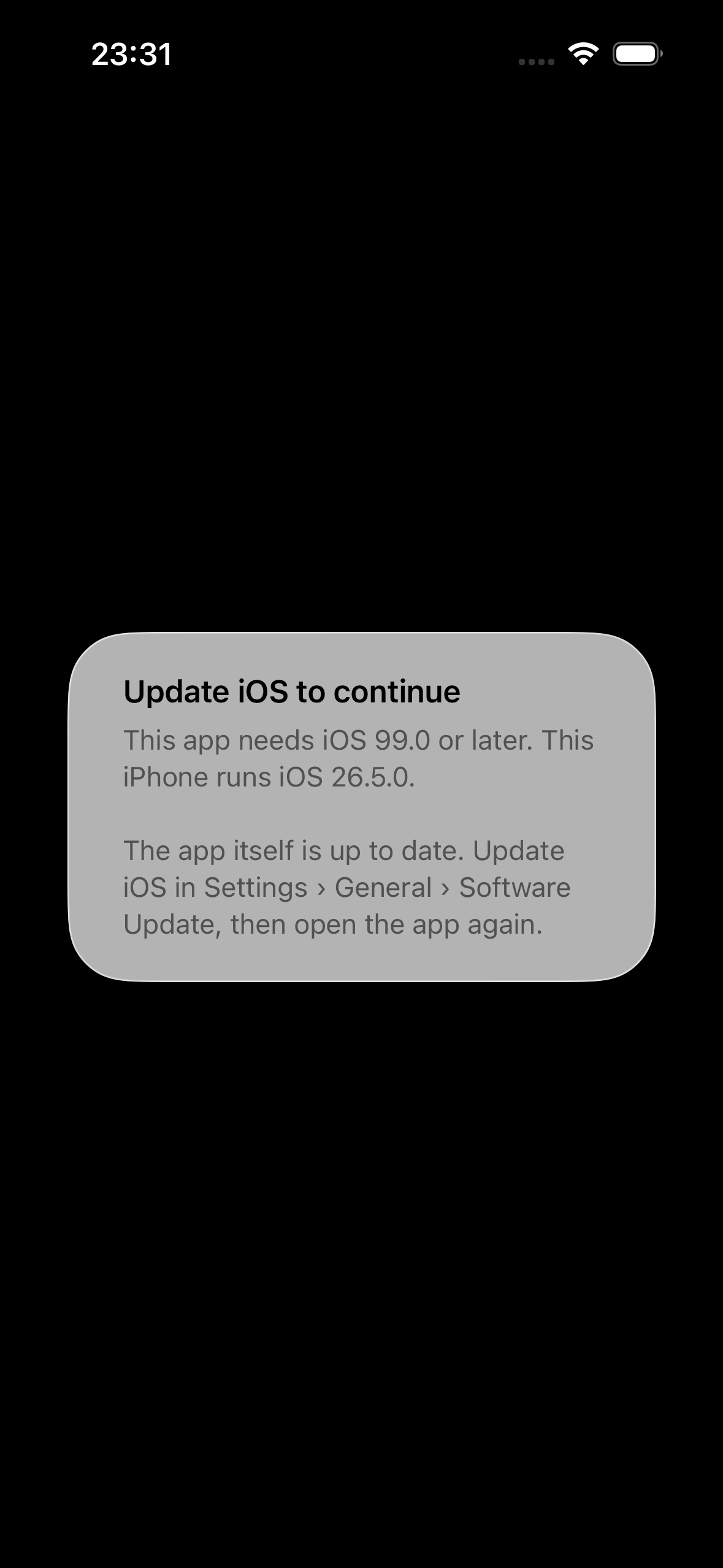
No iOS 16.3 runtime is installed on this machine, so the below-floor path was exercised on an iOS 26.5 simulator (a dedicated wg-guard-verify device, iPhone 16) with the floor forced through the example's launch-environment override: SIMCTL_CHILD_WEBVIEW_GUARD_EXAMPLE_MIN_IOS=99.0 xcrun simctl launch ….
| Run | Verdict | What appeared | Evidence |
|---|---|---|---|
| floor 99.0 | below_floor | Alert "Update iOS to continue — This app needs iOS 99.0 or later. This iPhone runs iOS 26.5.0." No buttons. Log: refused navigation to tauri://localhost, no app page load | screenshot · logs/ios26-forced99.log.txt |
| floor 16.4 (default) | supported | App loads; probe supported, IPC OK | screenshot · logs/ios26-default.log.txt |
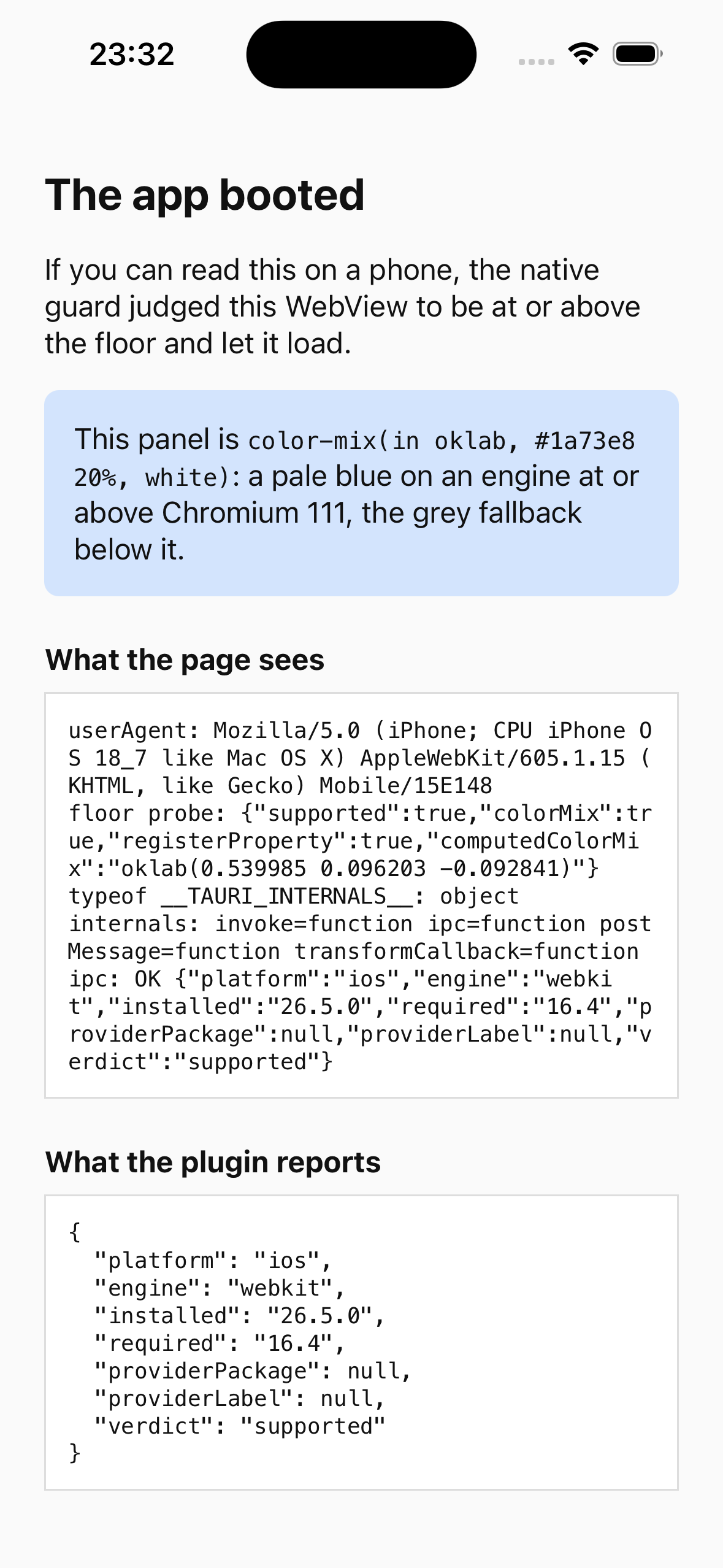
A side observation on the default run: WKWebView's user agent on iOS 26.5 says iPhone OS 18_7. User-agent parsing would have misreported this device by eight majors, which is one more reason the guard reads ProcessInfo.
The deployment-target trap was reproduced on the example itself: logs/ios-trap/. First tauri ios init with minimumSystemVersion: "16.4" → IPHONEOS_DEPLOYMENT_TARGET = 16.4. Changed to "17.0" and re-ran init → still 16.4. Added bundle.iOS.template and re-ran → 17.0. And "template": "ios-project.yml" (relative to src-tauri/) failed with "failed to read custom Xcode project template" — the path is relative to the directory the CLI runs in.
Mutation checks
logs/mutation-checks.txt. Each mutation was applied to the committed source, the relevant suite run, and the file restored from git:
| Mutation | Caught by |
|---|---|
Chromium >= → > | 3 tests, incl. chromium_boundary_is_inclusive |
| Chromium floor hardcoded to the default (111) | chromium_floor_is_configurable |
| Chromium floor hardcoded to 110 | chromium_boundary_is_inclusive, chromium_floor_is_configurable |
iOS >= → > | ios_boundary_is_inclusive_and_minor_aware, ios_floor_is_configurable |
| iOS compares the major only | 2 tests |
Navigation hook lets localhost through while blocked | nothing_but_about_blank_navigates_once_blocked |
Unknown also blocks (Android) / (iOS only) | unknown_never_blocks / ios_unknown_never_blocks |
Probe && → || | 2 probe tests |
Probe gates on color-mix() alone (the Safari 16.2/16.3 hole) | passes only when color-mix() AND CSS.registerProperty are both present |
One const in the probe | is ES5 — it has to parse on Chromium 53 |
| Probe ignores the page's template | renders the page-supplied template below the floor |
The iOS-only Unknown mutation initially survived — only the Android half had a test. ios_unknown_never_blocks was added and the mutation re-run red.
What this does not prove
- A real Play Store. Neither the
market:path nor an actual WebView update was exercised; both images lack the Play Store. The https fallback is what fired on both below-floor arms. - A Trichrome or OEM provider. All four arms report
com.google.android.webview. - iOS below 16.4 on a real OS version. The alert was forced on 26.5.
- Release builds. All runs are debug APKs;
proguard-rules.prokeeps the plugin's classes, but R8 was not run.